
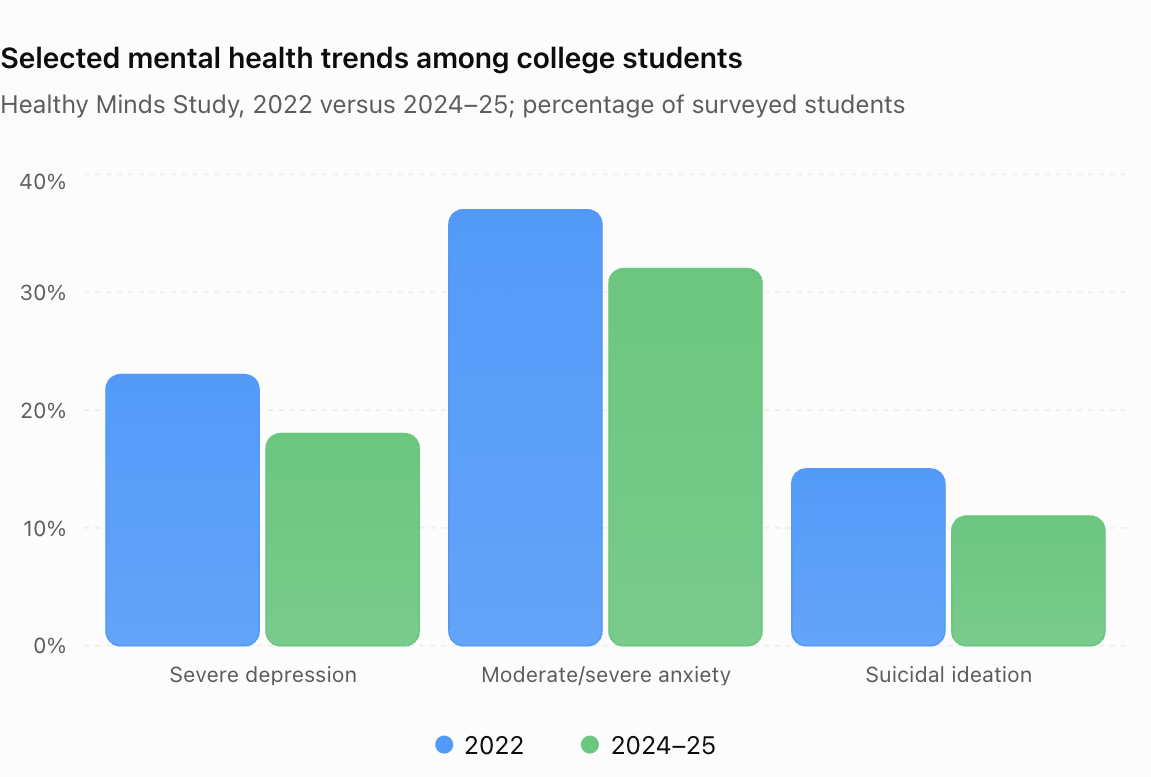
There is a substantial body of research suggesting that today’s college students face far more challenging demands than in times past, including greater mental health challenges, heightened financial worries, elevated family responsibilities, and other competing demands that directly interfere with a student’s ability to engage academically.1,2 For example a study involving more than 350,000 students across 373 campuses found that there was a near 50% increase in at least one mental health problem between the year 2013 and 2021. Surprisingly, even just comparing 2022 to 2024-25, there was also a substantial increase in mental health concerns, revealing its accelerating rate.3
As this problem becomes increasingly relevant, so do teaching strategies in effort to help remediate cognitive load and competing outside classroom problems. For example, research shows that it is not just reducing student workload, nor should it include eliminating rigor, but rather, through curricular efficiency and streamlining content. This includes improved assignment clarity and reducing unnecessary or unrelated assignment demands, which may actually help students to more deeply process and understand concepts. 4 In another study, researchers Sam Koudsia and Michael Kirchner (2024) examined how a more navigable, user friendly, visually and conceptually simple, to the point, with clear expectations in course design, contributed to lower cognitive demands on students, which became associated with improved academic success.5
In another revealing study involving 1,773 students in mathematics courses, found that instructors who clarified and simplified their course to only the meaningful content, predicted better engagement and higher achievement for their students. Particularly, the approach emphasized how scaffolding, structured practice, and feedback improved student learning, not just assigning “less work,”6—something that many believe is the only solution to compete with student attention.
As you can likely see, cognitive load and distraction can be managed, but it is not just by reducing the number of tasks or appropriate rigor, but by making the material more meaningful, structuring classes to be more predictable, and scaffolding lectures so that students can more easily learn and retain the material.
References
- Lipson, S. K., Zhou, S., Abelson, S., Heinze, J., Jirsa, M., Morigney, J., Patterson, A., Singh, M., & Eisenberg, D. (2022). Trends in college student mental health and help-seeking by race/ethnicity: Findings from the national Healthy Minds Study, 2013–2021. Journal of Affective Disorders, 306, 138–147.
- Armstrong-Carter, E., et al. (2022). A university-wide survey of caregiving students in the US: Individual differences and associations with emotional and academic adjustment. Humanities and Social Sciences Communications, 9.
- The Hope Center for Student Basic Needs. (2025). 2023–2024 student basic needs survey report. Temple University.
- Thornby, K.-A., Brazeau, G. A., & Chen, A. M. H. (2023). Reducing student workload through curricular efficiency. American Journal of Pharmaceutical Education, 87(8), Article 100015.
- Koudsia, S., & Kirchner, M. (2024). Reducing cognitive overload for students in higher education: A course design case study. Journal of Higher Education Theory and Practice, 24(10).
- Martin, A. J., Ginns, P., Nagy, R. P., Collie, R. J., & Bostwick, K. C. P. (2023). Load reduction instruction in mathematics and English classrooms: A multilevel study of student and teacher reports. Contemporary Educational Psychology, 72, Article 102147.