
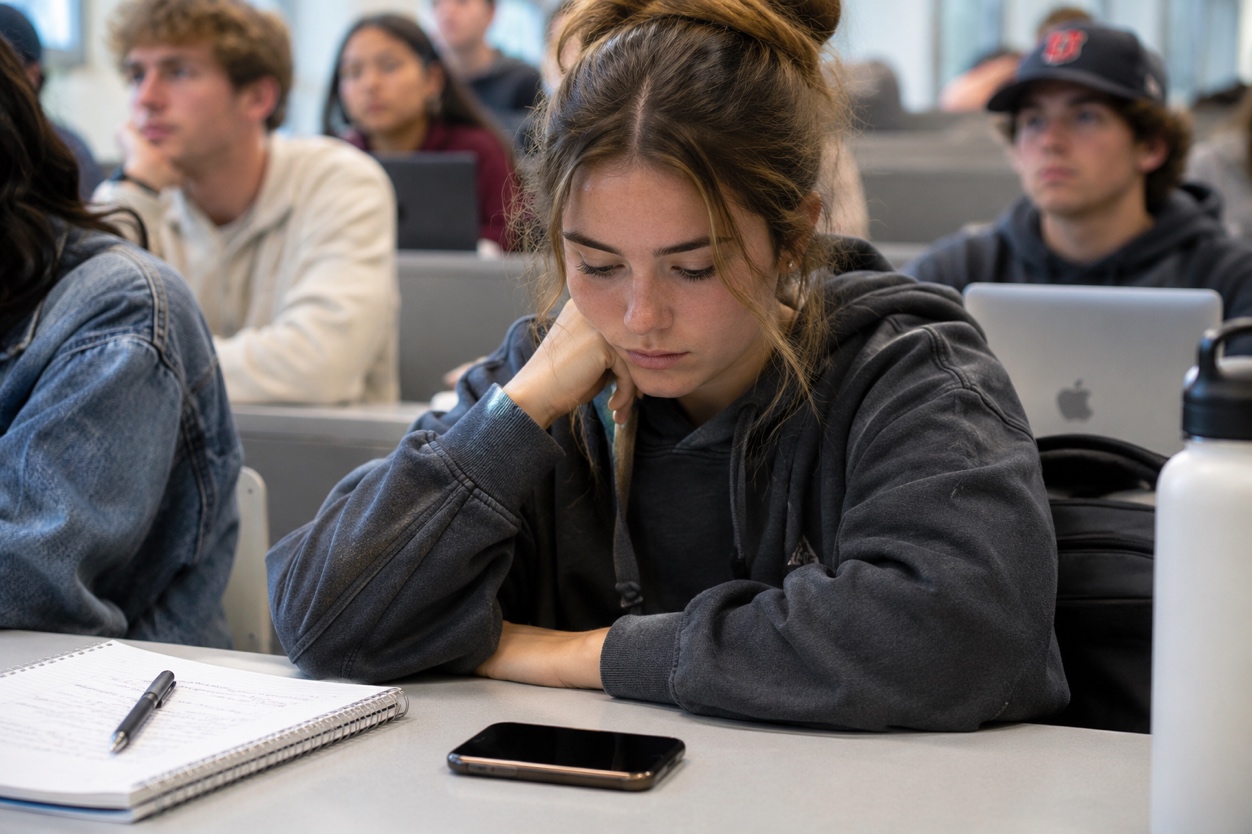
Imagine a time you were a grad student. Although you were likely busy, you may have been able to walk into class 5-10 minutes early, sit down at your desk, open your notebook, and quietly place your phone next to your notebook. You are indeed feeling well equipped for this lecture. But once the professor arrives and the lecture begins, your phone lights up with a notification. You glance at the notification, maybe respond to the message, and then return your attention back to the class.
A few minutes later, another notification piques your interest. You reach for your phone, intending to take only a quick glance, when you notice a news headline that catches your eye: “New Study Finds That People Who Check Their Phones Every Five Minutes Suffer Academically.” You resist the temptation to open the article and tuck your phone into your bag to minimize this distraction, but you find, however, that even though your phone is now out of sight, the headline is not out of mind. You start wondering what the study discovered, and your attention becomes divided, even long after you have put your phone away.
You might convince yourself that you are attentively listening to the lecture because you are doing what good students do, sitting quietly with your notebook open and taking notes intermittently, but the truth of the matter is, your brain is quietly multitasking, decreasing your ability to take in, think about, and encode important information you need to learn for the exam.
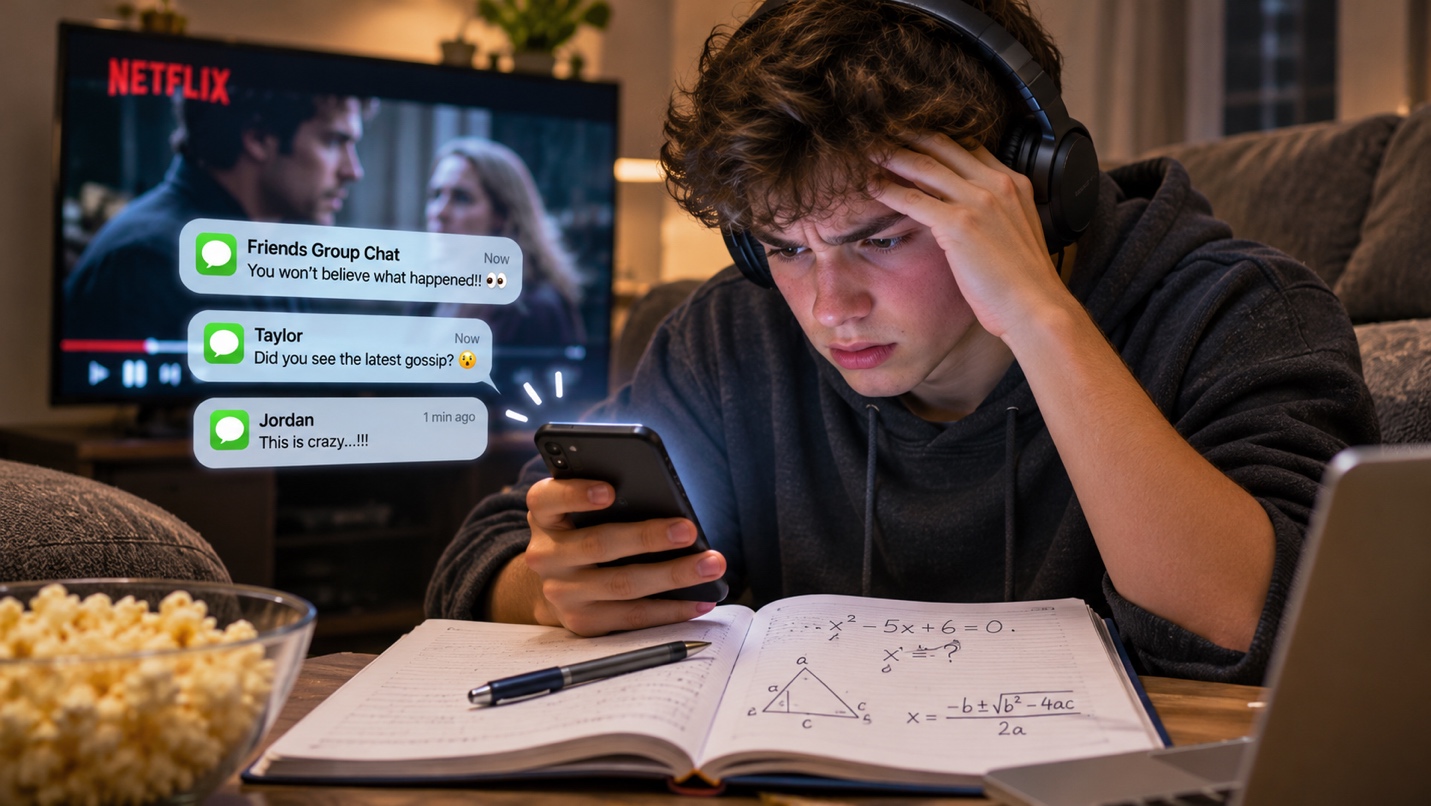
When students try to pay attention, solve problems, or attempt to understand unfamiliar concepts, they rely heavily on working memory, which is a limited-capacity system that temporarily maintains and manipulates information for later use.1 Working memory is important because it allows us to hold information in mind while doing something with it, like solving a mathematical problem by remembering the numbers, working toward the solution, while at the same time, monitoring progress. Now imagine another common scenario. What if this mathematical problem-solving was done in front of the TV while trying to watch your favorite Netflix series, while also constantly getting texts from friends containing the latest gossip? Your attention span would be exorbitantly pushed.
The prefrontal cortex, particularly regions that are involved in executive control, like the dorsolateral prefrontal cortex (DLPFC) and ventrolateral prefrontal cortex (VLPFC), play important roles in maintaining goals, directing attention, and coordinating necessary behaviors, and when we switch between demanding tasks, the brain must repeatedly adjust which information and goals are currently relevant. Researchers have demonstrated that this task switching can produce measurable costs in performance, which include slower responses and considerably more errors.2 In other words, what feels like doing two or more things at once actually involves alternating between them, but often without notice. And those transitions aren’t seamless.
In fact, one interesting study found that distractions that drag our attention away, doesn’t always require actively looking at our device. In a series of experiments, Ward and colleagues (2017) found that the mere presence of a person’s smartphone was actually associated with reduced performance, particularly those involving cognitive capacity.3 Interestingly, when the phone was nearby, even in a personal bag or turned off on the desk, it still drew cognitive resources. This is likely because students, and most everyone else, are so driven to check their phones, they have to actively inhibit the attentional shift that occurs toward their phones, and redirect attention back to the relevant task at hand, like the class lecture.
To help with cognitive load, and in effort to compete for students’ attention with all the modern-day distractions, including family, financial, and mental health concerns, what instructors can do is consider how much information students must process at any given moment. This is where presenting complex information in manageable segments, and highlighting the most important ideas, while providing opportunities for students to process what they have learned, can really help.
References
- Baddeley, A. (2012). Working memory: Theories, models, and controversies. Annual Review of Psychology, 63, 1–29.
- Rubinstein, J. S., Meyer, D. E., & Evans, J. E. (2001). Executive control of cognitive processes in task switching. Journal of Experimental Psychology: Human Perception and Performance, 27(4), 763–797.
- Ward, A. F., Duke, K., Gneezy, A., & Bos, M. W. (2017). Brain drain: The mere presence of one's own smartphone reduces available cognitive capacity. Journal of the Association for Consumer Research, 2(2), 140–154.