
If you think back to the time where you took an exam, you probably recall reading your notes, highlighted what you thought were important passages in the textbook, and reviewing the professor’s PowerPoint slides—or any other materials. You probably reviewed them several times, until you felt a sense of confident in your ability to do well. But when you actually take the exam, you suddenly realize you can’t remember an answer, or several answers to the questions you reviewed, even though you thoroughly reviewed them multiple times before.
One explanation as to why this happens, has to do with the difference between recognizing information and actually retrieving it from memory. Although these processes are related, they aren’t necessarily the same thing. Learning isn’t like putting information into a storage container, where we might read a chapter, listen to a lecture, or watch a video, and just like that, the information gets deposited into our brains, anticipating the later date of retrieval. The truth is, the brain doesn’t quite work that way.
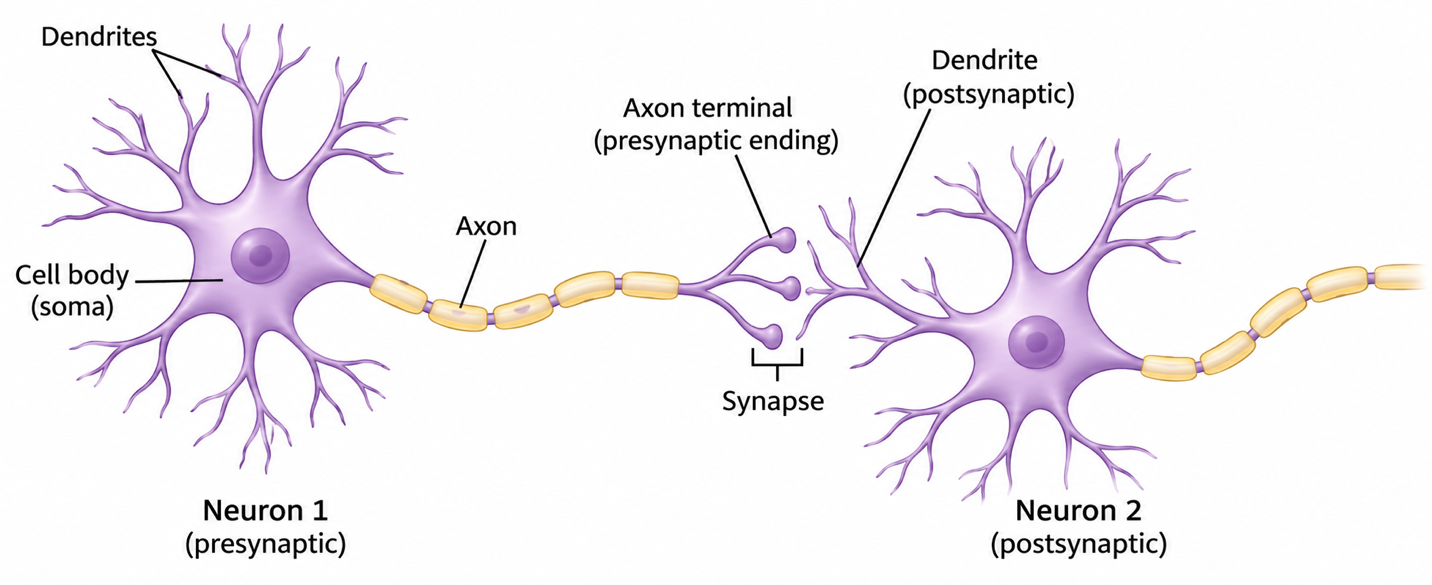
Instead, learning involves changes in how networks of neurons communicate, and one important process is long-term potentiation (LTP). LTP is a biological process where there is a strengthening of communication between neurons that are involved during that study or practice, and essentially, is the process by which your brain forms memories. Specifically, it means a strengthening of synapses (the connections between neurons via tiny gaps that pass an electrical or chemical signal) based on recent patterns of activity, which you may have heard as “neurons that fire together, wire together.”1 When viewed this way, we can understand why one of the most effective ways to strengthen long-term retention is to actually practice recalling information rather than continually reviewing it, known as retrieval practice.2
We also see why this method is more effective when we understand the role of the hippocampus in learning something new (like the information that might be on an exam). The hippocampus is a seahorse-shaped structure that is located in the medial temporal lobe of the brain, which helps organize and bind together the information we have just “learned”—and does so across different brain regions. Later, when it is time to retrieve that information, the hippocampus then starts reactivating patterns of neural activity that was associated with that learning. Think of it this way. When hearing the first few notes of a familiar song, sometimes, those few notes are enough to bring the entire melody to mind. In neuroscience, this is part of an important process called pattern completion, where partial bits of information can help to retrieve the complete memory.3
This act of retrieving can contribute to the strengthening of the memory’s future accessibility4 and this is also where things can become somewhat counterintuitive. Struggling to remember something can improve learning, when resulting in desirable difficulties. Psychologist Robert Bjork and colleagues describe desirable difficulties, as challenges that occur during learning which begin to improve long-term retention, even when they make the learning itself feel harder, at least initially.5 This is why incorporating brief, low-stakes opportunities for students to retrieve the information they have learned throughout your course becomes beneficial and may be even more effective than re-reading study notes alone.6
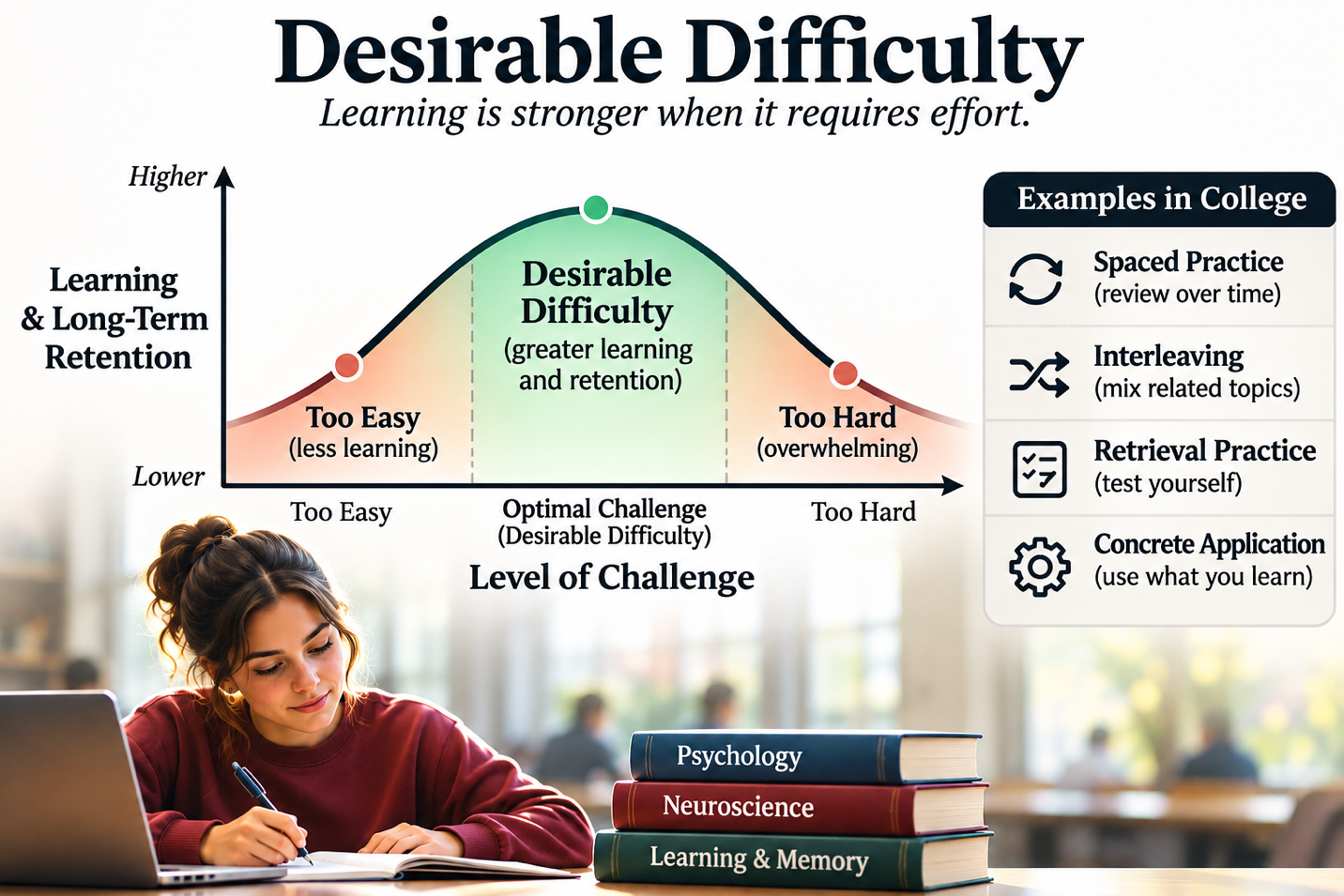
For example, in an in-person class you might introduce a concept, then ask students to close their notes and turn to their classmate to explain what they have learned. Or, you could begin class with a few questions about a previous lesson, textbook chapter reading, or the assigned homework, and ask them what they remember from it. If they struggle, give cues (prompts). Something that I often do in class is periodically interrupt the flow of the lecture/discussion with a slide that has a few quiz questions related to the content we just covered. I have students think about those questions, then turn to their partner to explain those concepts, and then redirect back to the class discussion where we can talk about those concepts as a group, in a think-pair-share activity.
In an online (or hybrid) course, where much of the material students need to learn is in a LMS (learning management system), I create short 3-to-5-minute videos, and at the end of each video present multiple choice questions for them to reflect and test the knowledge they’ve just learned. I also have students take a low-stakes 5 to 10 question quiz, and integrate other retrieval assignments, like a Read, Reflect and Describe assignment where they choose five concepts to describe in their own words, as well as connect them to real-life, everyday situations. Students have the option to submit this assignment through video or written format. As you can see, you can embed many retrieval practice assessments throughout the course, and sometimes it just takes a bit of creativity. Having students engage in effort and rigor, while at the same time preserving guardrails for success, appears to be the formula, as struggling a little helps the learning stick.
References
- Bliss, T. V. P., & Lømo, T. (1973). Long-lasting potentiation of synaptic transmission in the dentate area of the anaesthetized rabbit following stimulation of the perforant path. The Journal of Physiology, 232(2), 331–356.
- Karpicke, J. D., & Roediger, H. L. (2007). Expanding retrieval practice promotes short-term retention, but equally spaced retrieval enhances long-term retention. Journal of Experimental Psychology: Learning, Memory, and Cognition, 33(4), 704–719.
- Nakazawa, K., Quirk, M. C., Chitwood, R. A., Watanabe, M., Yeckel, M. F., Sun, L. D., Kato, A., Carr, C. A., Johnston, D., Wilson, M. A., & Tonegawa, S. (2002). Requirement for hippocampal CA3 NMDA receptors in associative memory recall. Science, 297(5579), 211–218.
- Antony, J. W., Ferreira, C. S., Norman, K. A., & Wimber, M. (2017). Retrieval as a fast route to memory consolidation. Trends in Cognitive Sciences, 21(8), 573–576.
- Bjork, R. A., & Bjork, E. L. (2011). Making things hard on yourself, but in a good way: Creating desirable difficulties to enhance learning. In M. A. Gernsbacher, R. W. Pew, L. M. Hough, & J. R. Pomerantz (Eds.), Psychology and the real world: Essays illustrating fundamental contributions to society (pp. 56–64). Worth Publishers.
- Roediger, H. L., III, & Karpicke, J. D. (2006). Test-enhanced learning: Taking memory tests improves long-term retention. Psychological Science, 17(3), 249–255.