
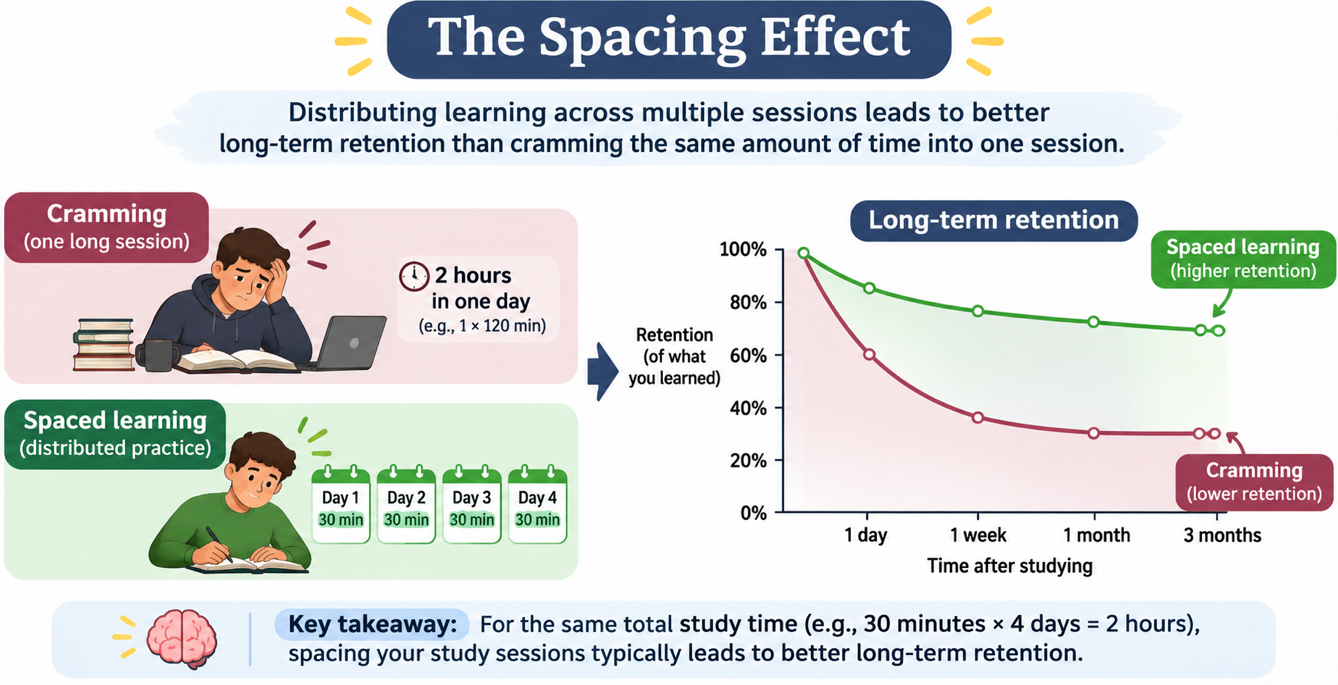
If you can reflect back when you were a student, you might remember a time when you spent several hours studying, only to find that much of the information you learned just disappeared in a few days. Interestingly, the problem may not be how much time you spent studying, but how you distributed that time. We often assume that the longer students study, the more they will learn. To some extent, that is true. Additional practice and review certainly help, but research consistently demonstrates that distributing learning across multiple sessions, rather than concentrating everything into one prolonged session, produces greater long-term retention. This is known as the spacing effect. For example, studying for 30 minutes across four separate days will often produce better retention in the long-term, than studying for two consecutive hours, even though the total study time is practically identical.1
But why does this spacing make a difference? Part of the explanation involves how memories are formed, how they become stabilized, and how they are retrieved at a later time. When we learn something new, the brain’s hippocampus, plays a central role in learning and memory, but also helps establish and coordinate those memory representations. However, most memories don’t become stable the moment they’re formed. Instead, they undergo a process known as memory consolidation. This process is where newly acquired information starts to become more stable and integrated with existing knowledge.2
One particularly interesting process includes the reactivation of neural activity that is associated with previous experiences. This is known as hippocampal replay. During certain periods of both quiet, relaxed wakefulness and deep sleep, patterns of neural activity that are associated with earlier experiences become reactivated, supporting memory consolidation.3 Although this doesn’t fully explain the spacing effect yet, it illustrates that learning-related processes can continue even after we’ve stopped actively studying and learning. In fact, to helps students leverage this spacing practice, in one learning and memory class I teach, I give homework to students, where they try in out for themselves, by practicing the famous pomodoro technique, a study strategy developed by Francesco Cirillo in the late 1980s.
The idea here is actually quite simple. Instead of trying to study for 4 hours straight without stopping (something common amongst students and busy adults), students instead break their study up in short periods of intensely focused attention, for example, a 30-minute study session, then followed with a brief break of about 5 minutes. Then repeated 2-4 times. It remains important here that the 5-minute rest is undistracted and deep rest—instead of picking up the phone to scroll through social media or watching tv, as stimulating activities during this rest period can interrupt this hippocampal replay.
The pomodoro technique also creates a healthy spacing practice, where each 30 minutes of studying one subject every other day or so creates opportunities to revisit the same information after some forgetting has likely occurred. When students return to the material later, they may have to work a little harder to remember it, adding an additional retrieval effort, which further supports long-term retention. This is one reason why spacing and retrieval practice work particularly well together. Rather than rereading the same material repeatedly, students who study it briefly, return to it the following day or the day after, and then revisit it again later in the week.
For instructors, incorporating spacing doesn’t necessarily require redesigning an entire course. Consider frequent short-stakes review of the material by revisiting important concepts from earlier weeks, including cumulative questions on quizzes, or even begin class with a short review of the previously learned material, and encourage students to begin studying well before an exam rather than waiting until the night before, otherwise known as massed practice, or in layman terms, procrastination. The goal isn’t to study longer, but more effectively in ways that our brain learns best.
References
- Cepeda, N. J., Pashler, H., Vul, E., Wixted, J. T., & Rohrer, D. (2006). Distributed practice in verbal recall tasks: A review and quantitative synthesis. Psychological Bulletin, 132(3), 354–380.
- Dudai, Y., Karni, A., & Born, J. (2015). The consolidation and transformation of memory. Neuron, 88(1), 20–32.
- Ólafsdóttir, H. F., Bush, D., & Barry, C. (2018). The role of hippocampal replay in memory and planning. Current Biology, 28(1), R37–R50.
- Cirillo, F. (2018). The Pomodoro technique: The acclaimed time management system that has transformed how we work. Currency.